

Stereo Camera Records: Depth and Disparity Differ
2026-11-05
Stereo Camera Records: Depth and Disparity Differ
Stereo Camera Records should distinguish disparity from depth before either is summarized as a distance map. In StereoLabs' account, disparity concerns the horizontal shift of matched visual features between the two views. The ZED SDK uses stereo matching and converts the resulting disparity information into metric depth. This article reads the manufacturer's explanations through a fictional robot-camera information note. It announces no new product, processes no images and measures no depth accuracy.
Locate disparity in the two-view account
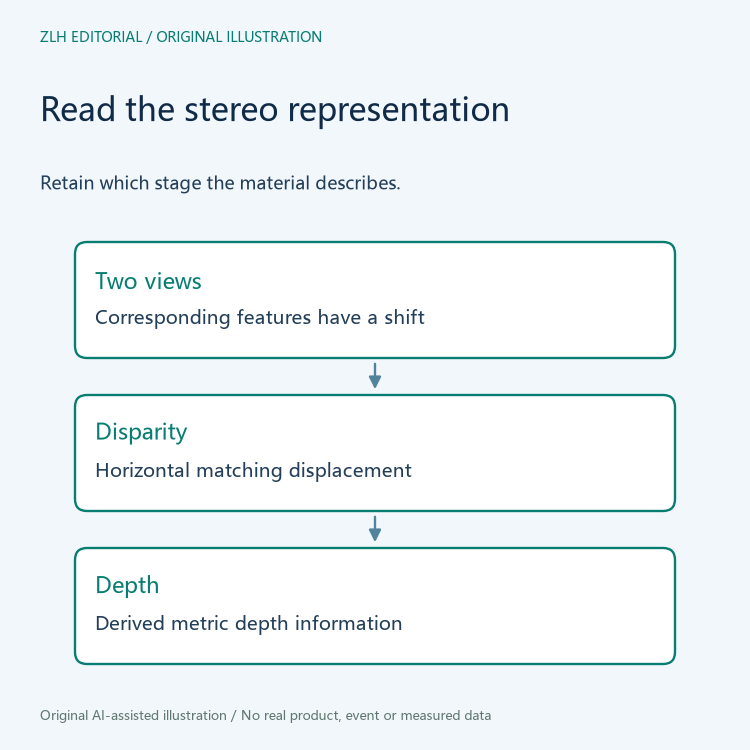
The official ZED 3D perception explanation describes matching visual features in the left and right images and measuring their horizontal shift. It calls that shift disparity and describes triangulation as the basis for the depth calculation. A device note should retain this relationship instead of calling every value in the matching representation an already measured metric distance.
For a fictional appendix, suppose a contributor names one attachment disparity and another depth. The first editorial question identifies the representation of each attachment and the supplied relationship between them. The labels alone do not establish that the second file was actually produced from the first, and this article has no files available to decode or compare.
Read depth as the derived metric representation
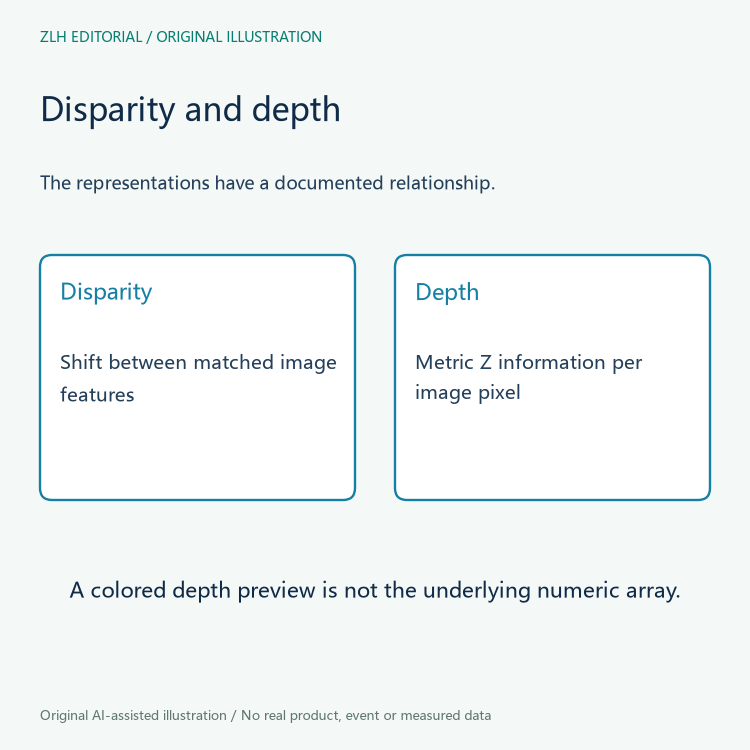
The manufacturer's Depth Sensing Overview describes a depth map as storing distance or Z information for each image pixel. It distinguishes that map from a point cloud containing X, Y and Z coordinates. This locates the depth representation without turning it into every possible spatial quantity.
A summary should therefore preserve that the field is depth information with its documented camera reference. It should not silently rename it a full 3D coordinate or treat the disparity representation as the same field. The actual record still needs its applicable format and source account. No coordinates or range values are supplied in the fictional note.
Preserve the conversion account without reconstructing it
The support explanation places rectification, stereo matching, disparity computation and conversion to metric depth in its description of the SDK. These are manufacturer statements about the processing account. Their presence in a manual does not demonstrate that an unknown contributed dataset underwent the claimed sequence.
A useful equipment note can name which stages the contributor says produced the attachment and retain the software context. It should not invent missing calibration, a baseline or a focal-length value to complete the story. This article gives no triangulation recipe, performs no conversion and selects no settings for a camera.
The distinction also matters when comparing descriptions from different versions or interfaces. A field name should retain its own documented meaning. If the contributor uses another output or software layer, ask for its applicable definition rather than assume that a familiar map label is sufficient to interpret the numeric contents.
A colored view is another representation
The overview explains that depth values can be mapped to colors for display. A colored preview can help a reader recognize structure, but its displayed colors are not automatically the numeric depth values. A caption should identify the view as a visualization and keep its connection to any underlying data explicit.
In the fictional appendix, receiving a colored image alone does not provide the original disparity or metric depth array. The editor can describe the supplied picture without claiming access to those arrays. This article has no camera picture, colored depth map or scene from which any values could be extracted.
Keep representation reading separate from performance claims
The sources also discuss operating conditions and product performance. This article does not adopt their range or accuracy figures as independent observations, nor does it infer that a camera is suitable for an unknown robot task. Distinguishing disparity and depth clarifies terminology; it does not complete a camera evaluation.
Actual accuracy or downstream behavior claims would need the relevant capture, task, method and observations. A map's presence is not itself such a result. The fictional note can remain useful by identifying the supplied representation and asking which material supports any further claim, while leaving unsupported performance conclusions open.
Publish the representation with its source
A clear device brief retains the attachment's name, representation, camera and software context, and the contributor's processing account. If a later revision corrects disparity to depth in a caption, identify whether the file changed or only its description was repaired. Those are different events and should not be compressed into camera improved.
The sources were read on November 5, 2026. The original diagrams show no real stereo images, calibrated geometry or measured values. Related reading appears in the robot camera source category and technical reference category. Stereo Camera Records stay understandable when matching displacement, derived depth and a displayed color view retain their separate roles.


