

Robot Model Source Notes: Adapter Files and Base Weights
2026-11-05
Robot Model Source Notes: Adapter Files and Base Weights
Adapter Files can make a robot-model research artifact easy to share while leaving an important dependency outside the supplied files. The PEFT documentation distinguishes adapter parameters from the base model's weights. A configuration can identify the base model without containing those weights. A source note should retain that distinction before describing a research attachment as a complete model package. This article reads documentation without downloading weights, loading a model or running any inference.
Identify what the research source actually supplies
A research summary may mention a checkpoint, an adapter or a model repository. These words should be connected to the artifact actually described by the contributor. Ask whether the supplied account concerns adapter files, a separate base model, a combined model or another representation. A small attachment alone does not reveal which of those cases applies.
Keep the artifact identifier, configuration description and source version together. If a paper or announcement uses a general model name, a file note should still identify the particular attachment it discusses. This article does not announce a new robot release or claim that any particular robotics project uses the documented layout. Its purpose is to clarify a file-scope question when a source does identify PEFT artifacts.
Read the documented adapter checkpoint contents
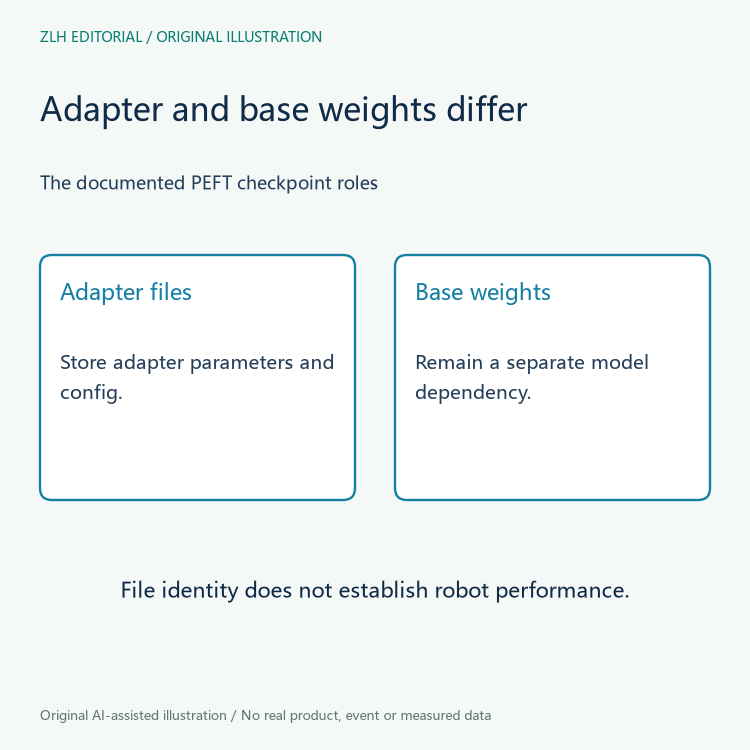
The official PEFT checkpoint-format guide describes adapter weight files and an adapter_config.json file. For the documented adapter state dictionary, the guide explains that the stored parameters belong to the adapter module rather than the base model. This is why an adapter attachment should not automatically be labeled a copy of all base weights.
The guide also discusses other storage arrangements, including a whole model containing base weights. The distinction here therefore depends on the declared artifact, not a rule that every file associated with PEFT has identical contents. Preserve the contributor's actual storage description. Do not infer a combined model merely because an attachment uses a familiar weight-file extension.
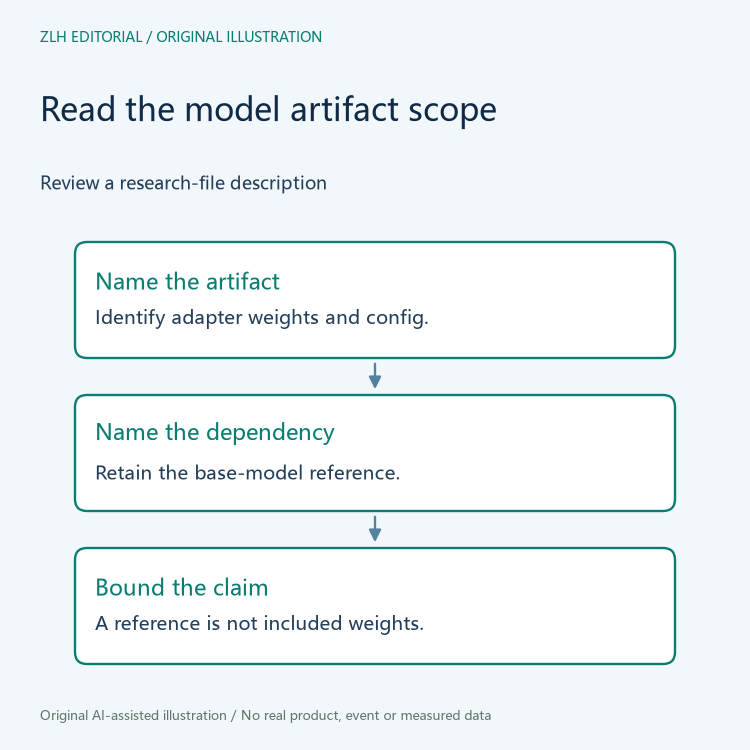
Keep the configuration's base reference separate from its payload
The checkpoint guide describes base_model_name_or_path and revision information in adapter configuration examples. These entries provide reference information about the base model where applicable. A reference field and the actual base-weight payload have different roles. Copying a model name into a configuration does not make its weight data part of that JSON document.
A useful source note retains the referenced identity and any stated revision without filling in absent information. If the contributor's model is outside the documented pretrained Transformers case, the guide discusses configurations where those entries can be null. A reviewer should not invent a base-model identifier simply to make a metadata table look complete.
Cross-check the versioned integration explanation
The official Transformers v5.4.0 PEFT guide likewise distinguishes adapter checkpoint files from base weights in its described workflow. It also explains that loading an adapter involves a base model and adapter configuration. Here that workflow is read as documentation; no loading procedure is reproduced or performed.
The PEFT source uses its main documentation branch, while the integration source is explicitly versioned v5.4.0. Both were read on November 5, 2026. Their scope should remain visible in a citation note. Combining them does not establish the behavior of every later library version, every adapter method or an unidentified robot-policy checkpoint.
Review a fictional artifact summary
Imagine a fictional robot-learning source note that lists an adapter weight file and its configuration, then calls the attachment a self-contained copy of the complete base model. The reviewer should ask which evidence supports that broader description. If the attachment is only the documented adapter package, its separate base dependency should be stated. This example identifies no real model, repository or experiment.
A corrected note could name the adapter artifact and separately identify the referenced base. It should not claim that the files have been successfully loaded, that dependencies remain accessible or that a particular robot task has been reproduced. Those statements need their own observations. Reading a configuration is useful without being turned into a deployment or evaluation report.
Leave model outcomes with their own evidence
File-scope clarity does not establish training quality, robot-task performance, licensing terms or suitability for an application. It tells a reader what the source says was shared and which dependency remains separate. If the contributor later supplies a different combined artifact, retain its distinct identity rather than silently applying the old adapter description.
The original figures show documentary roles without weights, model outputs or benchmark claims. Further reading appears in the robot research source collection and article directory. Keeping Adapter Files and base weights distinct makes a source note useful before any later authorized evaluation asks what the supplied model actually does.


