

Robot Software Sources: Read a Package Quality Declaration
2026-11-05
Robot Software Sources: Read a Package Quality Declaration
A quality declaration in a robot software source packet deserves more precise reading than a level number in a headline. ROS package categories connect a claimed level to documented policies, rationale and caveats. They should not be turned into a claim that a newly discussed physical robot has passed a complete assessment. This article reads REP 2004 and the rclcpp Jazzy declaration as source material. It announces no new release, runs no tests and audits no robot.
What does REP 2004 classify?
The official REP 2004 Package Quality Categories document describes quality levels for packages in the ROS ecosystem. Its dimensions include version policy, change control, documentation, testing, dependencies, platform support and security. The declared package is the object being discussed. A source note should not silently replace that package with an entire robot product or deployment.
Suppose a hypothetical robotics brief receives a repository link and a sentence saying level one software proves production readiness. The editor should identify the named package and the actual declaration supporting the level claim. The broader product sentence requires additional evidence. No actual brief or supplier is being evaluated here; the example illustrates how a package-level statement can be expanded beyond its documented object.
Why read the justifications below the heading?
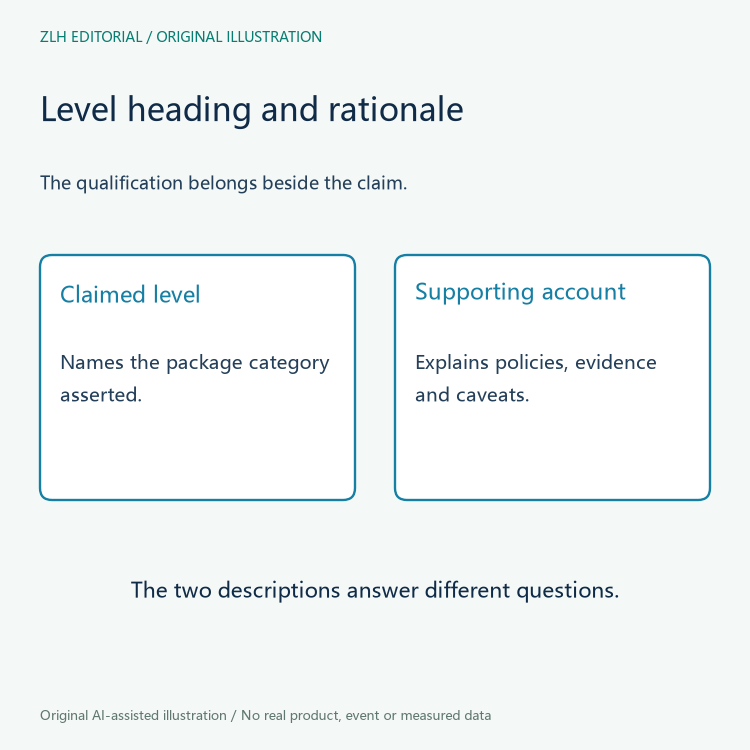
REP 2004 calls for a declaration that states the claimed level and addresses the relevant requirements with justification. It explains that claims are presented for users and potential peer review rather than enforced through a universal checking authority. A level heading is therefore an entry point into the rationale. The reader should retain exceptions and explanations instead of extract only the most favourable label.
The official rclcpp Jazzy quality declaration supplies a concrete example. Its opening claim places rclcpp in Quality Level 1 when used with Quality Level 1 middleware. Keep that condition with the claim. This source reading does not independently verify the current middleware of any submitted robot, and it does not extend the declaration to every package in an application.
How do policy statements and runtime evidence differ?
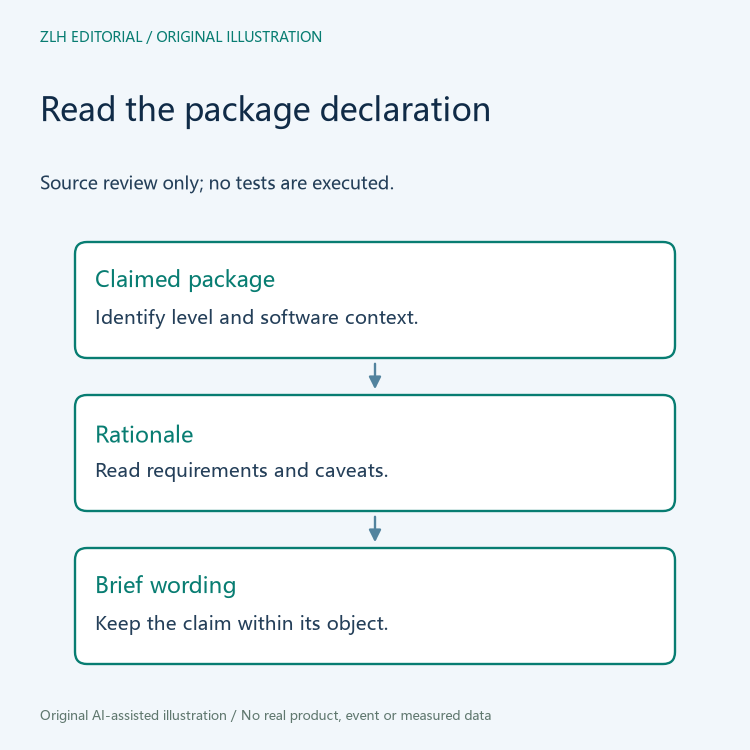
The rclcpp declaration is organized into sections covering policies, tests and dependencies, with links and explanatory text. A reader can describe what the declaration claims and what supporting material it identifies. That is different from personally inspecting every linked result or executing the package's test suite. An editorial note should state which activity actually occurred rather than treat reading a policy as a newly completed test.
For a hypothetical source packet, ask which version or branch the declaration belongs to and whether the relevant cited evidence has been supplied. A mutable branch can change later, so retain the actual snapshot used for the reading. A later declaration may be useful, but it should not silently replace the source that supported an earlier story about a different software context.
Coverage, performance policy and dependency explanations have distinct roles within the declaration. A high-level summary should not convert one dimension into a promise about all the others. Nor should a package's stated exception be hidden merely because it complicates the headline. The useful source account preserves the contributor's qualification and lets readers understand what still needs project-specific assessment.
What should a robot-software brief say carefully?
A bounded brief identifies the package, declaration context, claimed level and material qualifications. It can explain that the declaration organizes evidence about software policies without claiming an independent product certification. If a maintainer changes the declaration, identify the relevant change and source date. Do not call a documentation revision a newly deployed robot feature unless separate evidence supports that event.
The topic is also different from a target platform's support tier or a distribution's release status. Those are other source questions with their own documents. This article does not reclassify a distribution or identify a newly supported machine. A complete brief may need those records too, but a common numeral or the broad word supported should not merge their roles with the package quality claim.
Suppose the hypothetical editor corrects a sentence to say that the named package claims a level under a stated dependency condition. That correction improves attribution and scope. It does not prove the application's suitability, performance or safety. Those questions need the actual system, requirements and evidence. This reading has inspected no installed package set or physical equipment.
The two original figures contain only document roles and no test scores or product imagery. Related reading appears in the robot software-source category and related resource category. Reading a quality declaration beyond its heading lets a robotics brief preserve both the package's claim and the rationale a reader needs to assess it.


