

Robot Research Citation: Zenodo Version and Concept DOI
2026-11-05
Robot Research Citation: Zenodo Version and Concept DOI
A Research Citation can identify a robotics artifact without identifying the exact version used in a reported analysis. Zenodo distinguishes a version DOI from a concept DOI representing the collection of versions. Both are identifiers, but they support different citation scopes. This article reads Zenodo's own documentation and a fictional research-source packet. It does not publish a record, resolve a real study's findings or claim that any artifact makes a robot experiment reproducible.
Ask which object the identifier represents
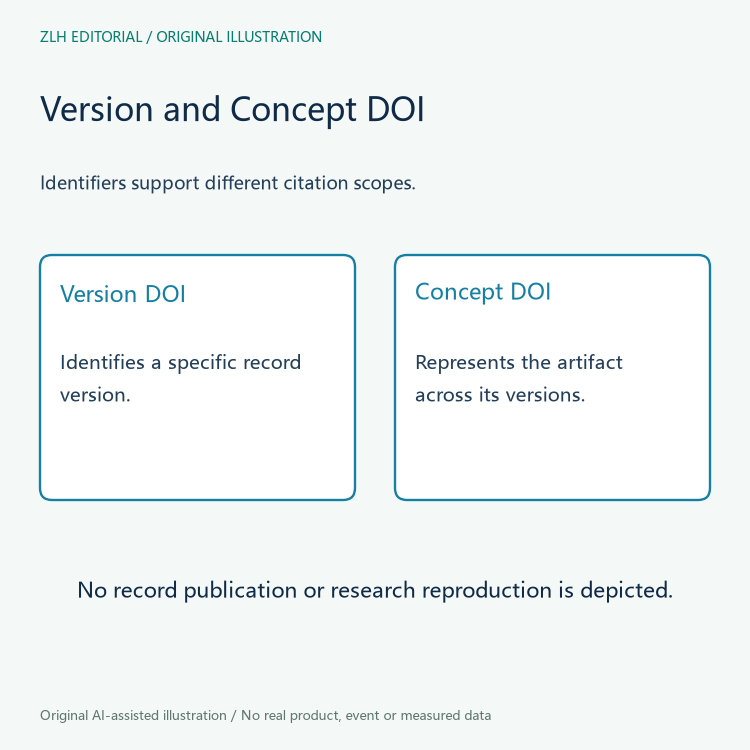
Zenodo's official DOI versioning explanation distinguishes the identifier of a specific record version from the concept identifier representing all versions. The distinction belongs in a research-source note. A citation intended to identify exact files should not be summarized as doing so merely because it contains a valid-looking DOI string.
The source also explains that concept and version identifiers are ordinary DOIs. Their different roles should therefore be established from the record's explanation, not guessed from a suffix or a visually distinctive number. A reporter should retain the supplied identifier and its stated role. Inventing a version suffix would create a different string rather than clarify the cited object.
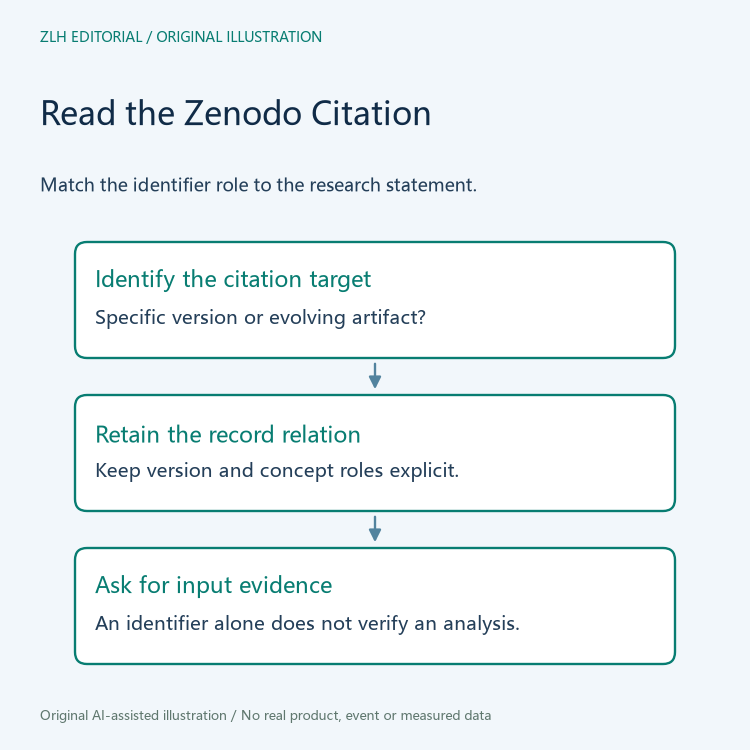
Keep an evolving artifact separate from an exact version
The versioning explanation says that the concept DOI resolves to the latest version's landing page. It recommends a specific-version DOI for the usual case of citing an exact artifact, while acknowledging reasons to cite an evolving artifact as a whole. The editorial choice should follow the claim being supported. A broad project description and a report about particular files need not use identical citation scopes.
A research note should say what the contributor intended to identify. If the packet discusses exact evaluation inputs, ask which version supports that statement. If it discusses a continuing resource, preserve that broader purpose. Do not silently replace one scope with the other to make a reference list look uniform. Consistent formatting cannot repair an unexplained citation target.
Read new-version documentation beside metadata changes
The official Manage Versions page describes a new version as a separate record with its own metadata, files and persistent identifier, linked to previous and future versions. It distinguishes that process from editing metadata and points readers to separate guidance for minor file corrections. This article does not turn the page into an absolute statement that every visible record change must represent a new version.
That matters when a robotics source note sees a changed title or description. A metadata correction is not automatically evidence that the files used for an analysis changed. Conversely, a version change should not be reduced to a cosmetic title edit without checking the record's account. The contributor needs to identify what changed and which record the research statement concerns.
Review a fictional packet with an unspecified input version
Imagine an explicitly fictional source packet called Robot Willow Study. It says a particular set of artifact files was used for an analysis, but supplies only a concept DOI and no version account. The documentation question is which exact record the contributor intended. The packet does not justify the reporter choosing the current latest version and asserting that it was the original input.
A focused clarification asks the contributor to identify the version supporting the analysis statement and retain the relationship to the broader artifact. If the contributor cannot supply it, keep the limitation explicit. An accessible current landing page may still be useful for discovery without answering the historical input question. This example contains no real study, DOI or experiment result.
Suppose a later reply supplies a version identifier. That can improve the citation-target account, but the reviewer should still ask whether it actually supports the described files. A new reference does not retroactively prove the original analysis or validate every conclusion in the study. Citation identity is one evidence relationship within a larger research account.
Do not convert an identifier into a research endorsement
A DOI helps identify a resource. It does not establish that the work was peer reviewed, that the artifact runs correctly or that a robot achieves the reported outcome. Those claims need their own sources and evidence. The versioning pages explain record relationships, not the quality of a particular robotics experiment. Keep that limitation visible when shortening the source note for a daily brief.
No DOI registration, record editing or artifact execution occurs here. The reader can improve a citation account by asking what it identifies and why that scope matches the statement. That is useful preparation for research reading without pretending that the documentation task has reproduced the work.
Leave a source note another editor can follow
A bounded final note can state that the cited resource is a specific version or an evolving artifact, with any unresolved file relationship named plainly. The site's research-reference category and related-information category offer further reading. Retaining the identifier's role allows another editor to understand the intended source without inventing a release date, an evaluation input or a research result.


