

Robot Research ORCID FAQ: Read Identity Beyond a Name
2026-11-05
Robot Research ORCID FAQ: Read Identity Beyond a Name
An ORCID iD can help identify a researcher across research records, but its appearance beside a robot announcement does not establish the announcement's performance claims. A source review needs to separate the person being referenced from the evidence supporting the result. This FAQ reads ORCID's own documentation through a hypothetical robotics paper and news brief. It does not investigate a real researcher, authenticate a supplied identifier or evaluate an actual robot experiment.
What is the persistent identifier intended to do?
ORCID's explanation of its services describes a unique, persistent identifier for individuals engaging in research, scholarship and innovation, a connected record, and APIs supporting connections to affiliations and contributions. That purpose addresses identity and relationships in research information. It should not be expanded into a certificate that every statement associated with a named person is correct.
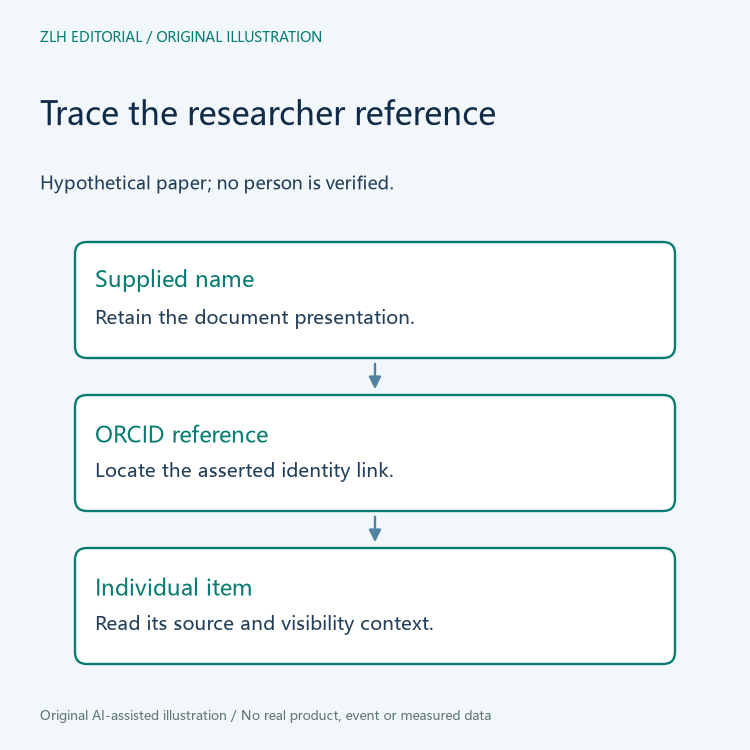
Imagine a hypothetical robot research brief in which an author's name appears in different forms across two documents. Retaining a supplied ORCID iD gives the reviewer a specific identity reference to examine alongside those names. The review still needs to establish where that reference came from and which document asserts the association. Matching text alone should not erase uncertainty, and an unexplained difference in name presentation should not become a claim of misconduct.
How are names represented in the record documentation?
The ORCID Record Schema guide annotates example XML returned through the 3.0 API. It separates the person section, including names and other names, from activities such as works, employment and funding. The guide uses an example sandbox record. Its sample content should not be copied into a news brief as evidence about an actual researcher or an actual robotics contribution.
For the hypothetical brief, preserve the name printed on the paper, the identifier supplied with it and the source of any additional name form. Do not substitute a preferred display name into a quotation without explaining the change. The goal is a traceable reference, not a forced uniform spelling. When the available materials leave identity uncertain, the editorial note should say which association needs confirmation rather than guess from an institutional label.
Why does the source of an individual assertion matter?
The schema guide documents source information for fields editable by the user or an API client. It explains how the contributing client or user can be represented. This makes an individual item and its provenance relevant objects of review. A researcher identifier and a work assertion are connected, but they are not the same information. Retain the source context when a research brief relies on a specific record item.
Suppose the hypothetical news writer wants to say that a particular work belongs to the identified researcher. The evidence file should show the supplied work reference and the association being relied upon. It should not simply show an identifier at the top of a page and assume that every nearby text item has identical provenance. An organizational assertion and a self-entered assertion also should not be silently described as if they came from the same source.
What can a public view leave unresolved?
ORCID's schema documentation explains visibility settings for record items and describes public and restricted access. A reviewer should therefore state the scope of the view actually examined. The absence of a visible item is not by itself a complete history of the person's research activity. Neither this guide nor a partial public record establishes that an unlisted contribution did not occur.
For the hypothetical review, retain the access context and date of the supplied material. If a provider later supplies a record item or a clarification, attach it to the question it answers. Avoid overwriting the earlier note in a way that makes a partial view appear comprehensive. The revision record can explain the additional evidence without inventing a new publication, affiliation event or correction by the researcher.
Does identified authorship establish the robot result?
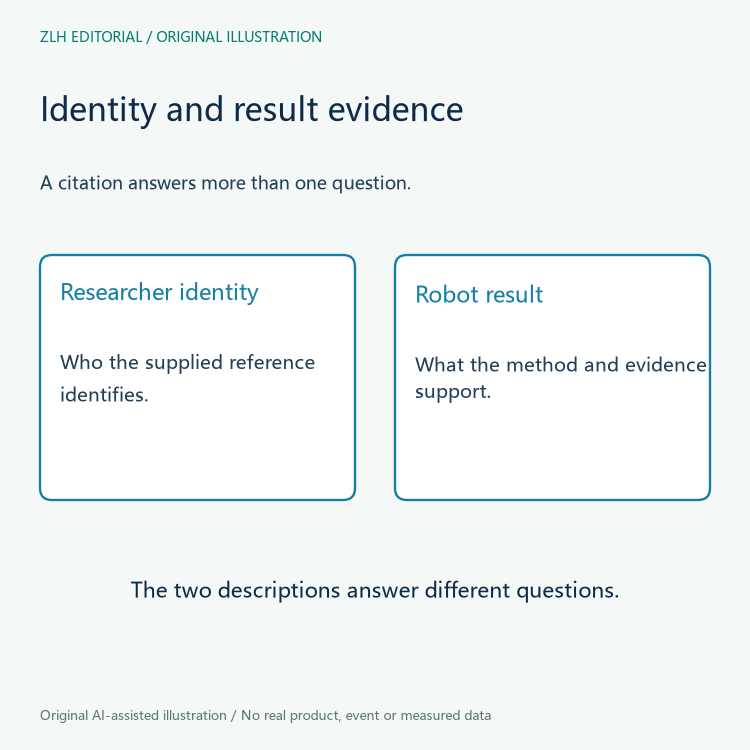
Even a well-supported identity relationship leaves the experiment's method, conditions, data and limitations to be examined in the research source. A robot demo claim requires evidence relevant to that claim. An ORCID reference serves a different part of the citation record. This article has read no experimental dataset and reports no replicated result, measured improvement or finding about a real author's work.
A bounded editorial finding can name the researcher reference, the document association and the specific assertions inspected, then identify the remaining performance questions separately. The conceptual figures illustrate those documentation objects without using a real person's identity. Further reading appears in the technical material category and related resource category. Keeping ORCID identity evidence distinct from a robot result makes a research brief easier to trace and more accurate about what its sources establish.


