

Robot Research Sources: Review DOI Metadata and Full Text
2026-11-04
Robot Research Sources: Review DOI Metadata and Full Text
DOI metadata can help a robotics editor identify a research work and prepare a reference. Receiving a formatted citation or a structured record is different from receiving and reading the full paper. A source pack should explain which material it actually includes before a news claim is accepted. This article uses a fictional editorial handover and does not report a new robot result, download a paper or test a DOI service.
Identify the delivered source object first
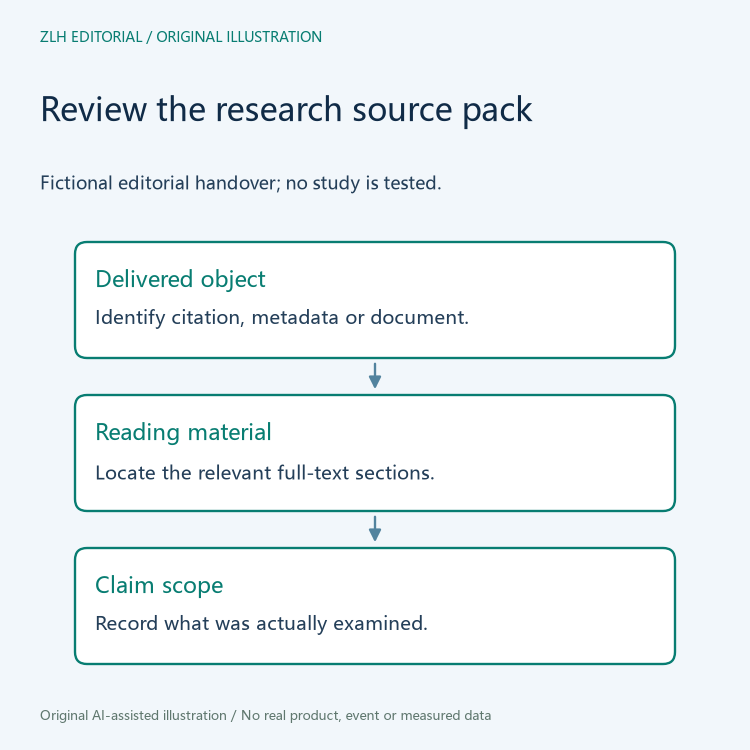
Suppose a fictional contributor supplies a bibliography entry and says the source has been retrieved. The editor should ask whether the delivered object is citation text, structured metadata, a landing page or the research document itself. Each can be useful, but the word source does not erase their different roles. A reference may locate a work without containing its methods, limitations or supporting material.
Keep the contributor's exact identifier, file type and retrieval explanation together. If the pack contains only a citation, label it accordingly. Do not expand an attractive research title into a performance claim or infer missing methodological details from the venue name. The acceptance question is whether the supplied materials let the editor read the evidence required for the proposed story, not whether the reference looks polished.
Content negotiation can request a metadata representation
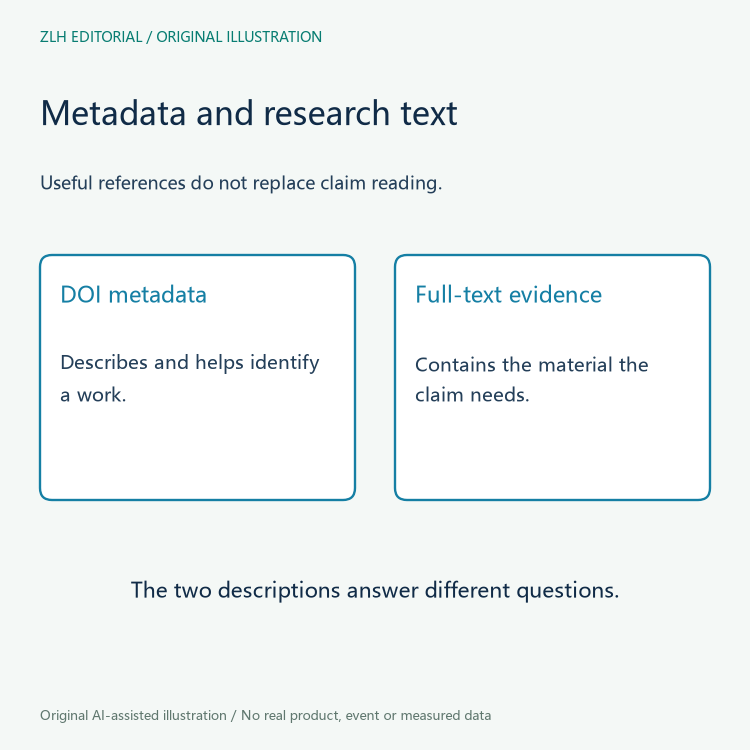
Crossref's content negotiation documentation explains requests for a single metadata record in a specified format using an Accept header. It lists formats including CSL JSON, BibTeX and RIS, and notes that mappings between schemas can lose distinctions. A successful metadata representation should therefore be described at its own scope, rather than as a complete copy of the underlying research.
In the fictional handover, the provider might include a structured record alongside a formatted reference. Ask which representation was supplied and whether any fields were transformed for display. The editor need not run a network request to recognise the distinction. A format conversion may change how a reference looks while leaving the central editorial task unchanged: obtain and read the work that supports the claim.
Resolver destinations depend on the requested representation
The DOI Foundation's explanatory documentation distinguishes normal HTML resolution to a resource landing page from negotiated requests that generally reach a registration agency's metadata service. It also describes response codes for unavailable metadata or unsupported requested types. This explains why two retrieval descriptions for one identifier can concern different objects; it is not evidence that a specific robotics paper is freely accessible.
A contributor should preserve the final material delivered and explain its relation to the identifier. If the source pack stops at a publisher landing page, say so. A landing page may supply useful publication information, but it does not establish that the editor has reviewed the entire work. Likewise, an unavailable representation should remain an availability finding, not be rewritten as proof that the research result is false.
Move from reference identification to claim evidence
For a fictional robot manipulation story, the editor may need the experiment description and reported task boundaries. Those requirements arise from the proposed claim, not from the citation format. A bibliography entry cannot establish the tested object, evaluation conditions or applicability to another setting. Request the relevant sections and any essential supplementary material, then identify the statements the eventual story can support.
If access to the full work has not been obtained, retain that limitation in the handover. The editor can still record the reference and unresolved questions. Do not fabricate an abstract, assume that a metadata field reproduces every qualification, or present an unexamined conclusion as independently checked. This article has reviewed documentation about representations, not the content of an actual robotics study.
Accept a source pack with its reading status visible
Retain a distinction between a missing field and a field changed by a display transformation. If a contributor cannot explain a discrepancy, preserve both representations and request clarification. A tidy reference list should not conceal the uncertainty that another editor needs to resolve before publication.
A useful acceptance note names the metadata received, the full-text material available and the portions actually read. It can distinguish reference identification from claim verification without dismissing either task. If another reviewer later adds a paper, keep the document version and the associated reading note. That creates a clear path from a citation to evidence while preserving the limits of each earlier handover.
For more editorial reading methods, explore the site's technical material category and related resource category. These categories do not authenticate research findings. The central discipline is to describe the delivered representation accurately, then require claim-specific reading before turning a reference into a statement about what a new robot has demonstrated.


