

Robot Research Claims: A Random Seed Needs Context
2026-11-04
Robot Research Claims: A Random Seed Needs Context
A robot-learning announcement may mention a fixed random seed as evidence that its experiment can be reproduced. The seed is useful documentation, but it is only one part of the claim. A reader still needs to know which generator received it, which environment the experiment used and what result was actually compared. This article examines a fictional research note. It does not reproduce a study, run a model or report robot performance.
Identify what the announcement means by reproducible
Start by translating the headline into an evidence question. Does the author mean that a particular random sequence can be regenerated, that a training run gave matching outputs in one environment, or that an independent group obtained a similar research conclusion? Those statements have different subjects and require different records. A seed value cannot tell the reader which subject was intended. Ask for the claim's scope before seeking additional numbers.
For a hypothetical example, imagine a study note saying that a robot policy used a recorded seed, while a supplement lists a software environment. There are no actual experiment results in this example. The reader can ask how the seed relates to the named process and whether the supplement describes the same run as the announcement. A nearby configuration file is not automatically the configuration that produced the result. The relationship must be stated or supported by the supplied record.
Keep a framework seed within the documented environment
The PyTorch 2.15 reproducibility note expressly limits guarantees across releases, commits and platforms, and discusses differences between CPU and GPU execution even with identical seeds. It treats controlling randomness and avoiding nondeterministic operations as related but separate concerns. The source supports a qualified reading of a seed, not a universal promise of identical results.
A research editor should therefore retain the framework version and the reported execution context with the seed statement. If the announcement does not identify these, mark the missing context rather than inventing it from the newest available documentation. Do not turn the present reference page into evidence that the study used that version. The reference explains terminology; the study's own materials must establish its environment and the comparison it claims to have performed.
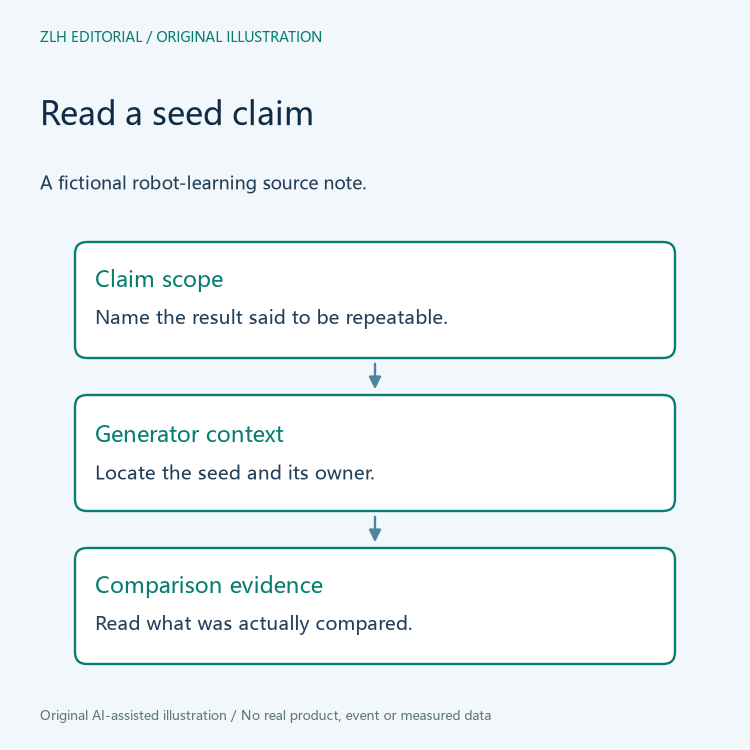
Ask which random generator was initialized
The NumPy Generator reference distinguishes a Generator from its BitGenerator and explains the seed input to default_rng. It also states that this constructor does not manage a default global instance and that Generator has no version compatibility guarantee for its bit stream. A reference to a seed without a named generator leaves an important relationship unspecified.
In the fictional supplement, one component might refer to a framework seed while another uses an independently created generator. That is a question to investigate, not a discovered defect in an unseen codebase. Request an account of the random sources relevant to the claimed comparison. A short map connecting components to their documented generator configuration can be clearer than a long list of seed values with no explanation of ownership.
Distinguish a configuration record from comparison evidence
A configuration explains intended inputs. A run record explains what was reported to have happened. A comparison explains the relationship between outputs under a stated rule. None of these documents should stand in silently for the others. A note that says the same seed was used can support a statement about the intended setup while leaving the actual comparison unresolved. An editor should say which layer was available for inspection.
Suppose the hypothetical paper reports similar aggregate behavior while a publicity sentence says identical runs. Ask the authors which wording matches the comparison they performed. Do not assume that numerical identity, qualitative similarity and repeatable physical behavior are interchangeable. Robot-learning results also concern particular tasks and evaluation conditions; a software seed does not expand those conditions. Keep the corrected claim attached to the experiment described in the source rather than treating it as a general product capability.
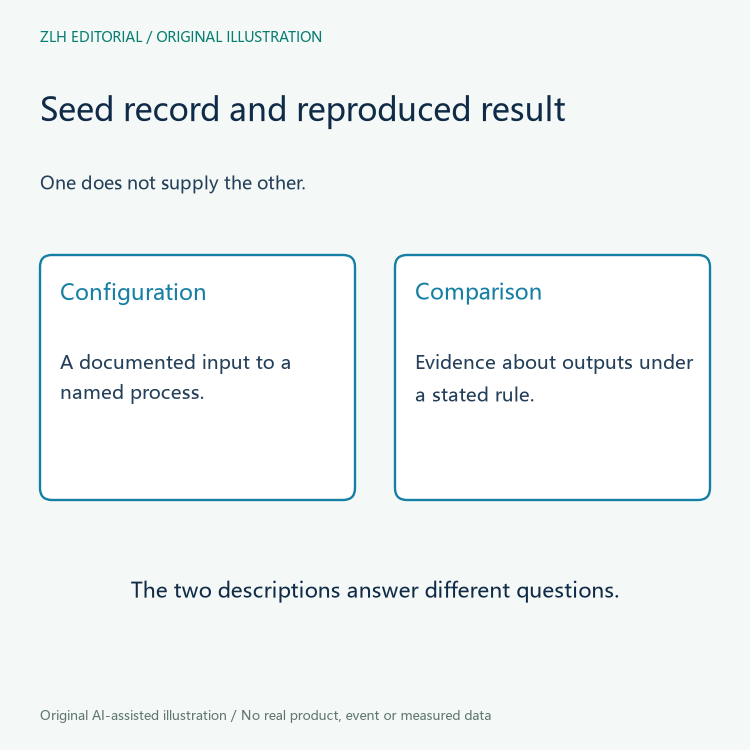
Publish a source note that another reader can follow
A useful editorial note identifies the announcement, the precise seed-related statement, the supplementary material examined and any unanswered environment question. If the authors later clarify the generator or comparison, retain the clarification with its date and reference. A clarification can improve the explanation without demonstrating that an independent reproduction has occurred. Use language that distinguishes documentation supplied from experiments actually reported.
The strongest supported outcome of this reading exercise is a better defined claim. It helps readers understand what evidence they would need for a broader conclusion while avoiding a blanket rejection of useful seed information. Our technical information category and related resources category provide navigation for further robotics-documentation topics. These category links do not identify a completed reproduction or certify a research result.


