

Robot Software Citation: Read the CITATION.cff File
2026-11-04
Robot Software Citation: Read the CITATION.cff File
What a CITATION.cff File Actually Declares
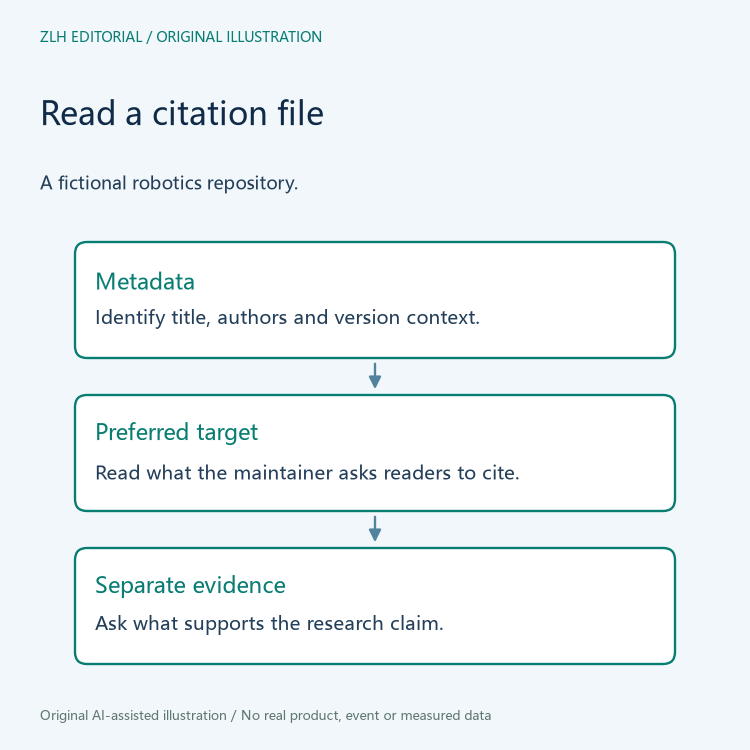
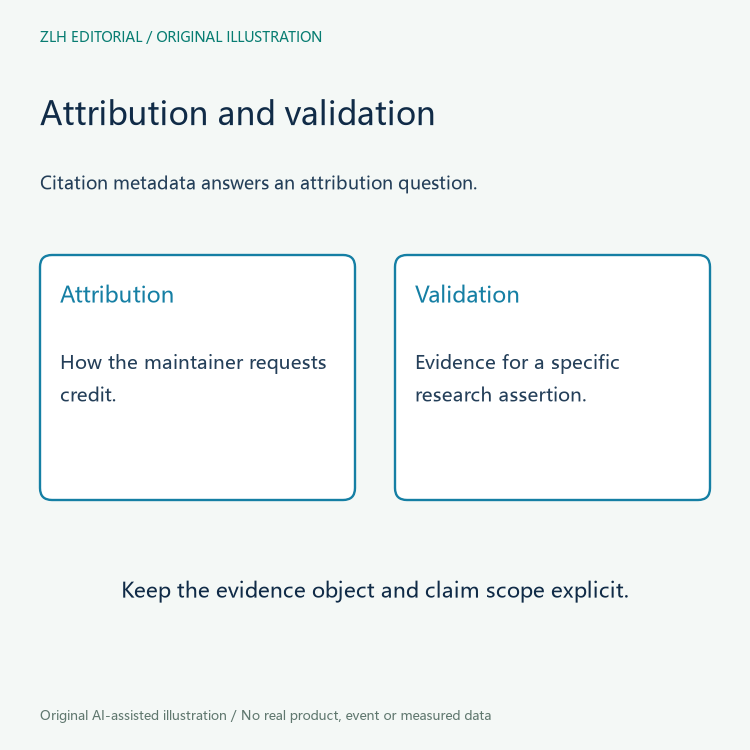
A CITATION.cff file is a plain-text file that lives in the root of a repository and carries citation metadata in a human- and machine-readable form. According to GitHub's documentation, the file format is plain text with human- and machine-readable citation information, and the Citation File Format project describes it as a way for developers to tell others how they would like their software cited. The file typically includes fields such as cff-version, message, authors, title, version, date-released, and a URL or DOI. None of these fields is a peer-review verdict, a deployment record, or a reproducibility statement. They are a citation request: a structured answer to the question "how should someone credit this software?"
The Citation File Format site notes that software and datasets have no title page, so the relevant citation information is often less obvious. A CITATION.cff file solves that problem by making the maintainer's chosen name, version label, author list, and identifier explicit. That is useful, but it is a metadata convenience, not a quality seal.
Preferred Citation and the Scope of the Override
GitHub's documentation explains that a repository can use the preferred-citation override in CFF to point the citation prompt at a different resource, such as a research article, rather than the software itself. The override supports types including article, book, conference-paper, data, report, manual, and others. When the override is set to type: article, the GitHub citation prompt renders an article-style citation in APA and an @article entry in BibTeX, using the fields supplied inside preferred-citation.
This matters for reading a repository carefully. A preferred citation is the maintainer's recommendation of what to cite, not evidence that the recommended article has been peer reviewed, accepted, or even published. The file can point to a DOI and journal name, but the file itself does not verify the article's status. The distinction between a citation request and a publication claim is easy to blur when the rendered output looks like a formal reference.
What the File Does Not Establish
Three common overreads are worth separating. First, the presence of a CITATION.cff file does not establish peer review; a rendered citation is not an observation of a review process. Second, citation metadata does not by itself establish deployment on a named robot or in a named environment. Third, a version label and release date are not evidence of successful reproduction. Any additional assertions or links in a particular file must be read and checked in their own scope, rather than assuming that the format itself has verified them.
The Citation File Format site does mention that the format can record references the software builds on, which is a provenance-adjacent feature. But listing a reference is not the same as demonstrating that the software reproduces the referenced work. A reader who wants reproducibility evidence needs to look beyond the citation file, at documentation, tests, and logged runs.
A Hypothetical Repository-Reading Example
Imagine a reader encounters a robotics repository with a CITATION.cff file in the root. The file lists a title, a version, an author list with ORCID identifiers, and a DOI. The preferred-citation block points to a journal article with a DOI, volume, issue, and page range. The reader might be tempted to conclude that the software has been peer reviewed because the preferred citation looks like a published paper. That conclusion would be unsupported. For this fictional example, the supplied metadata describes what the maintainer wants cited and how; it does not provide an independent review record. It does not show that the article passed review, that the software was deployed, or that the results are reproducible.
A careful reader would instead treat the file as a starting point: note the version and date, check whether the preferred citation resolves to a real article, and then look for separate evidence about review status, deployment, and reproducibility. The file is a map to a citation, not a map to a validation record.
Reading Citation Metadata Alongside Research Claims
When a robot research news story cites software, the CITATION.cff file can help the reporter and the reader identify the correct version and author list. That is a genuine service. But the file should be read as one layer of a larger evidence stack. The GitHub documentation notes that the citation prompt renders APA and BibTeX from the file, which is convenient for attribution. The Citation File Format site notes that tools can convert the file to other formats such as RIS and CodeMeta, which helps metadata flow between systems.
None of that flow is a substitute for checking whether the research claims attached to the software are supported by logs, tests, or independent replication. A citation file can tell you what to credit; it cannot tell you whether the credited work is correct, deployed, or reproducible. Keeping those questions separate is the core editorial discipline when reporting on robot research software.
Primary reference for the document terminology discussed here: https://docs.github.com/en/repositories/managing-your-repositorys-settings-and-features/customizing-your-repository/about-citation-files.
Primary reference for the document terminology discussed here: https://citation-file-format.github.io/.
Related reading: technical information category, related resources category.


