

Agile ONE SN News: Define the Reference Platform’s Role
2026-11-03
Agile ONE SN News: Define the Reference Platform’s Role
A reference platform gives researchers a starting configuration for a question they still have to define. That is a useful way to read the October Agile ONE SN humanoid announcement. Rather than treating a named research stack as a completed application, a reader can ask what role the supplied configuration plays in a proposed study of robot skills. The distinction makes the announcement more concrete without adding a performance result that the published material does not establish.
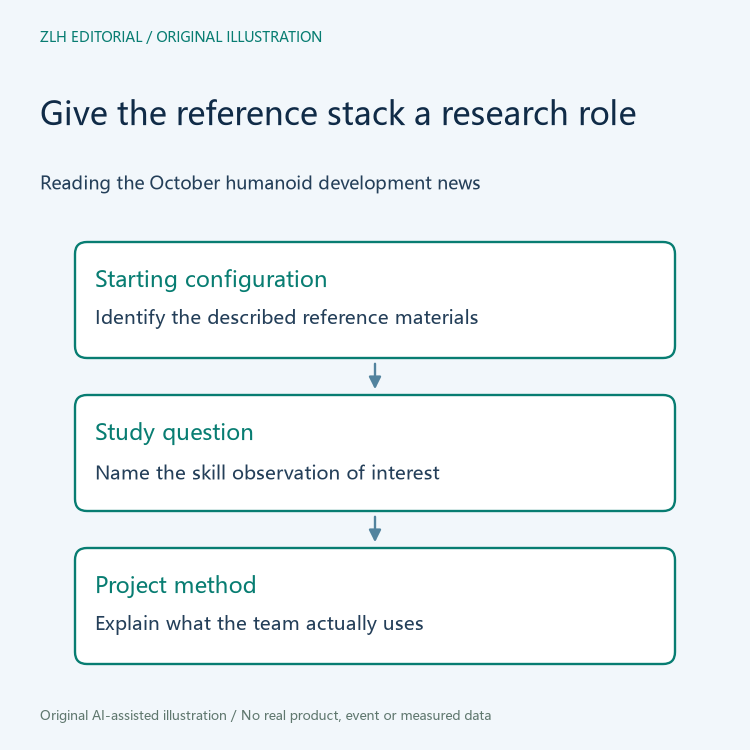
Identify the reference configuration described by the sources
Agile Robots' current humanoid page describes Agile ONE SN as a reference platform based on Agile ONE S, with Wuji hands and a configuration for NVIDIA Isaac GR00T. The NVIDIA announcement of October 21, 2026 places the humanoid within a broader robotics development-platform expansion. These are statements from the participating companies about the development offering.
The configuration is the relevant object for this reading. Its description tells the reader where to begin asking about the supplied research stack. It does not answer every question about a proposed task, study material or observation method. This article does not examine ordering arrangements, report delivery status or evaluate a physical humanoid. It focuses on the relationship between a reference configuration and a research question.
Give the proposed skill study a subject
Suppose a hypothetical research team wants to study a particular manipulation skill. Before the platform description can help, the team needs to explain what it wants to observe. A task label alone may leave the relevant objects, conditions and outcome unclear. A more precise statement names the intended activity and the evidence that would answer the study's question. This is an editorial example, not a study conducted with the announced robot.
The team can then identify which part of the reference stack is relevant to that question. One component may provide a starting point for development while another requires task-specific explanation from the provider. The author of a proposal should make those roles visible instead of letting a list of product names serve as the entire method. This helps collaborators understand what is supplied and what remains their own work.
Preconfiguration can be useful without eliminating that responsibility. A researcher still needs to know the applicable documentation and the boundaries of the proposed activity. This publication does not infer a control procedure, a training dataset or a completed skill from the fact that software and hardware are described together. Each would need its own source and study context.
Define observations separately from development milestones
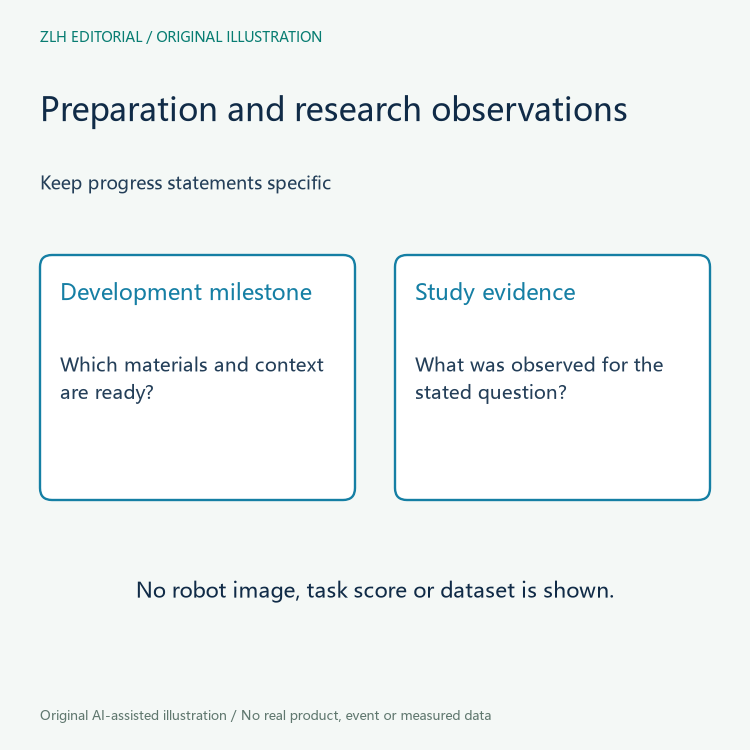
A proposal might describe obtaining materials, preparing a development environment and collecting observations as different stages. Its records should say which stage was actually reached. Having the expected components available is one milestone; answering a research question requires the relevant observations. Clear distinctions prevent a preparation update from being read later as a report of successful robot behavior.
If a demonstration is supplied, ask what it was intended to show and which conditions belong to it. A short presentation can introduce a system while leaving the evidence required for another task unaddressed. The reader should neither dismiss the demonstration nor enlarge it. Describe its stated role and retain the questions that need additional material from the responsible research team.
Keep task-specific changes visible in the study record
Research often develops beyond a starting configuration. If the hypothetical team changes part of its setup, the study record should identify the change and explain its relation to subsequent observations. A reference-platform name may remain useful background, but it cannot describe every later decision made by a project. Without that distinction, collaborators could discuss different setups using the same shorthand label.
The record should also distinguish the team's own method from the vendor's description. A provider can explain what it offers; a study author explains what was actually used and observed. Attributing those statements helps later readers assess the evidence without treating one source as responsible for claims made by another. No such project record has been reviewed for this article.
Read the October development as a starting point
The announcement identifies a particular humanoid reference configuration within a development ecosystem. Its value for a prospective reader is to make the starting point more recognizable and the follow-up questions more specific. A task's actual suitability, method and results remain matters for the applicable documentation and observations. The platform description is useful context for that work, rather than a replacement for it.
Both original illustrations are conceptual study-reading aids, with no product likeness or measured outcome. Related discussion appears in the new robot development collection and article directory. A precise research question allows reference-platform news to inform a proposal while preserving the difference between a configured starting point and knowledge gained through an actual study.


