

Robot Software News: Separate Closed and Merged States
2026-11-02
Robot Software News: Separate Closed and Merged States
Merged states and closed states answer different questions when an editor reads software activity associated with robotics. A closed item should not automatically become a story that code was merged, released, or delivered in a robot product. This article proposes a source-reading exercise using prepared GitHub documentation. It queries no repository, changes no issue or pull request, and reports no actual project event. The goal is to identify the object and the state claim before writing a news sentence.
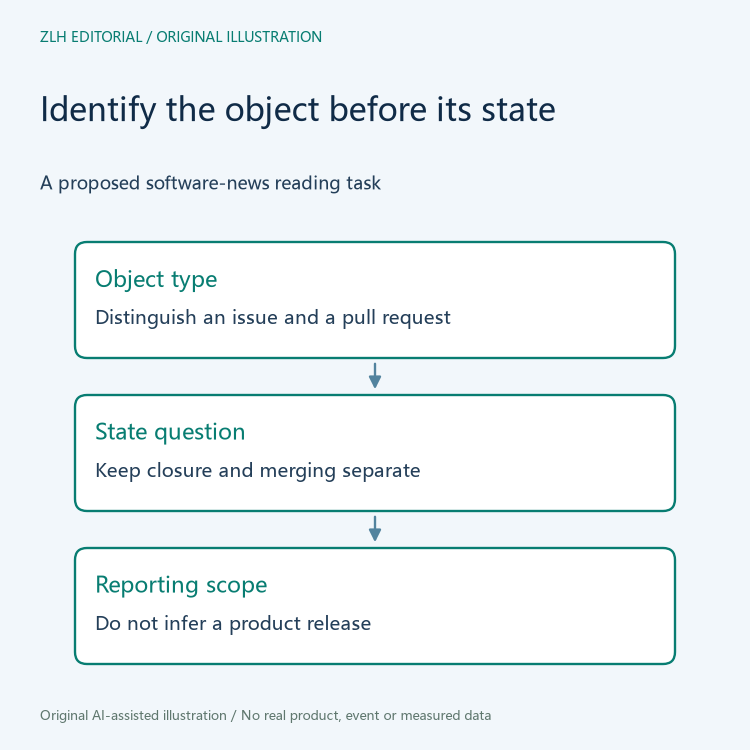
Identify whether the item is an issue or a pull request
Begin with the kind of object the prepared material describes. GitHub’s REST issue documentation explains that issue endpoints can include pull requests and identifies the pull_request key as a distinction in such responses. A general list should therefore not be assumed to contain only one object type.
For the fictional lesson, ask the learner to explain what information would establish the object type. Do not infer it from a title that mentions a fix or from a discussion that sounds technical. The review needs the platform’s actual representation, if a later authorized task examines one.
This article includes no copied repository response. Documentation examples explain a mechanism; they are not current activity records for a robotics project. The learner should keep example material separate from any eventual reporting evidence.
Write the closed-state statement at its own level
A state label describes the object and context to which it belongs. Before using it in a news sentence, identify both. An editor should not replace a narrow statement about an item’s state with a broader claim about the availability or quality of software.
In the proposed exercise, one learner drafts a sentence about an item being closed, while another asks what object the sentence names. If the object disappears into a vague phrase such as the fix is finished, revise the wording. That phrase may imply more than the prepared information establishes.
The exercise does not determine why any actual item was closed. A reason would need its own source context. Do not invent a successful implementation, a rejected proposal, or a maintenance decision simply to make the hypothetical story sound complete.
Look for the merge-specific question separately
The GitHub pull-request documentation provides a dedicated operation for checking whether a pull request has been merged into the base branch. This distinction is useful for planning a review: the merge question has its own relevant object and representation.
A later authorized editorial task should inspect the applicable pull-request information rather than infer merging solely from a general closed label. It should also preserve the actual request context before interpreting a response. This article makes no API call and treats no response code as an observation of a real project.

Keep the branch relationship with the merge statement. Even an established merge into a named branch would not, by itself, demonstrate that users have received the change in a released package or an equipment delivery.
Separate repository activity from product conclusions
A news note may need to discuss a software project and a robot product in the same article. That does not make their states identical. The relationship between project activity, a release, a supplier build, and a physical installation needs actual evidence for each claim.
For the fictional class, ask the learner to underline words that imply delivery or observed performance. Then ask what source would support each word. If the prepared material only explains an object’s state, narrow the sentence to that state and leave product implications open.
No demonstration result, certification, customer deployment, or performance improvement is reported here. The lesson concerns source interpretation. It should not turn a platform status into an endorsement of a robot or a prediction about when a change will reach users.
Keep a source note that another editor can audit
A useful planned note identifies the object type, the specific state question, and the additional evidence a stronger statement would require. If an actual review later occurs, attach the observed source and context to that note. Do not substitute a documentation example for the project record.
Ask a colleague whether they can tell which statement concerns closure, which concerns merging, and which would concern a release or product. The sentences should remain understandable without guessing the writer’s intended meaning. If the levels merge, revise before publishing.
Related methods appear in our robot-software news section and the article directory. Both original diagrams contain no real project identifiers, API output, branch events, release claims, or robot performance results.


