

Open Robotics Strategy: An Aspiration Is a Direction
2026-11-02
Open Robotics Strategy: An Aspiration Is a Direction
A strategy document can describe where an organization wants its technology to go without announcing that every part of the destination has been reached. For a robotics news reader, recognizing that kind of statement is part of understanding the news itself. The 2026 Open Robotics technology strategy distinguishes aspirational goals from annual priorities. This article reads the official announcement and strategy on November 2, 2026, and considers how a small fictional news desk might explain their relationship to actual project delivery.
Read the document’s own categories first
The April 13 announcement says the strategy sets long-term aspirational goals and priorities for projects in 2026. It describes the document as guidance for projects and contributors. That gives the reader a starting point: this is a statement of direction, with more than one planning horizon.
The strategy page names priorities concerning Physical AI, accessibility and ease of use, and modern production tooling. It explains that projects use priorities to guide roadmaps. A roadmap relationship does not, by itself, establish which features a particular project has delivered in a particular release.
These facts are enough to explain why the document matters without inventing progress figures. The fictional desk can tell readers that it gives context for project decisions. It should not turn the existence of a strategy into a numerical score for platform readiness.
The phrasing inside a strategy also deserves attention. A sentence describing what users should eventually be able to rely on carries a different meaning from a release note describing a change already shipped. Quoting only the attractive middle of that sentence could remove the context that makes its meaning clear.

Follow one idea across different planning levels
Imagine that the fictional desk wants to cover ease of use. At the strategic level, that can mean making it easier for people to begin work and understand a platform. At a project level, it could motivate more specific work. At a release level, a published change would need its own evidence.
The desk should therefore decide which level its story actually covers. A strategy interpretation may explain the reason behind a priority. A project update may explain planned work. A release report may describe an implemented change. All can be useful, but they answer different reader questions.
This example deliberately contains no invented project milestone. It does not assert that a new installer, documentation site, or production feature has shipped. If a later story makes such a claim, the author should read the actual relevant project material rather than infer completion from the annual strategy.
A clear article can connect levels without collapsing them. For example, it may explain that a stated project effort relates to a wider priority while separately describing the evidence available about that effort. The connection is explanatory; it should not transfer a completion claim from one level to another.
Ask what would support a delivery statement
If the fictional desk wants to say that a particular capability is available, it needs material about that capability and its actual context. An upstream strategy can help explain why a team might invest in it, but a delivery statement needs a narrower basis.
The author can retain an open question when that basis has not yet been read. That is preferable to writing a confident summary whose certainty comes only from the organization’s intention. A reader should know whether the desk is explaining direction or reporting an observed project outcome.
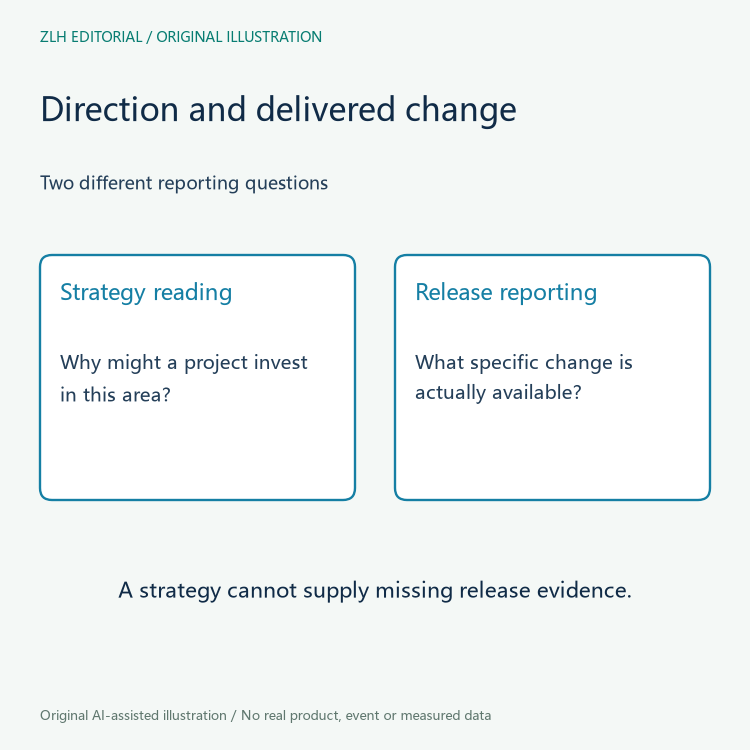
The same discipline applies to comparisons. A strategic aspiration to improve developer experience does not supply measured installation times, productivity gains, or a ranking against another platform. This article reports no benchmark and has not tested any robot software.
Nor should the calendar supply the missing evidence. Reading a 2026 document late in the year does not establish that all its ambitions have been realized. The status of actual work remains a separate reporting question even when the planning year is nearing its end.
Give the reader a useful interpretation
The news value of a strategy lies partly in showing which problems an organization considers important. A reader can use that context to follow later project announcements more intelligently. The author does not need to pretend that the document itself is a finished product.
For the fictional desk, a concise interpretation could explain the planning levels and identify a relevant question for future coverage. It can remain specific and informative while acknowledging that no implementation result has been established in the article.
Related coverage appears in our robotics news interpretation section, with more topics in the reading directory. Both original diagrams are explanatory illustrations, containing no actual project roadmap, completion percentage, or measured software result.


